Short answer
Beyond the court itself, budget for the slab or base (we estimate about US$7,000 per court), unloading the container, import duties and VAT, a power supply for the lights, planning permission, and possibly a roof. Smaller items are drainage, fencing around the site, insurance and maintenance equipment. Ask every supplier to state in writing what is and is not included.
Why padel court prices look cheaper than they are
Many suppliers quote a court “from” price that covers only the structure at the factory. Freight, turf, lights and installation then arrive as separate lines. Our prices include court, turf, lights, galvanizing, freight and installation, so the list below is what remains on your side.
1. The slab or base
A padel court needs a level, reinforced concrete slab of about 15 cm, with a drainage fall outdoors. A local contractor builds it to our drawings. We estimate about US$7,000 per court including run-off, but ground conditions, access and local labour rates can move this a lot. In the UK, a porous asphalt build-up is common instead. On sloping ground, the Prism Pano can stand on a raised platform base without a slab. More in padel court foundations.
2. Unloading the container
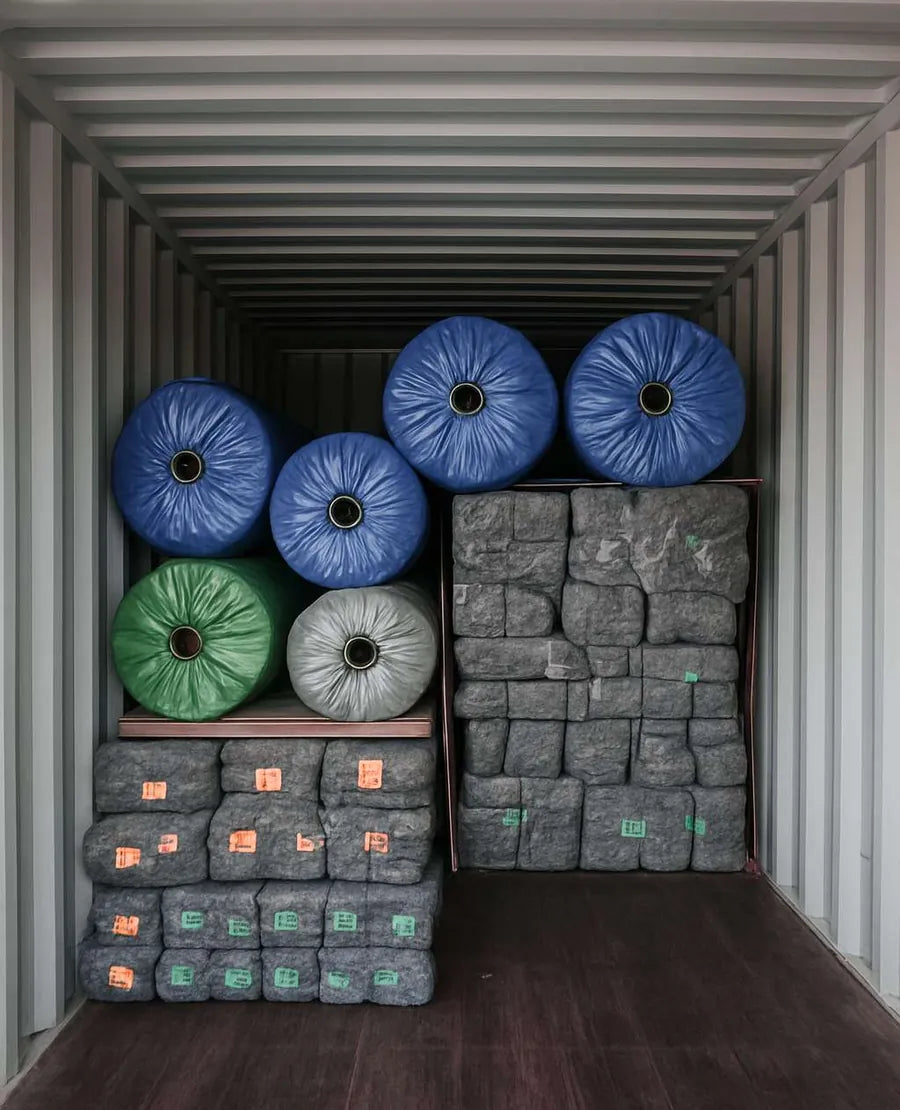
Our prices are delivered to your site (DAP). Unloading is not included. Plan a forklift or small crane and three to four helpers for a few hours per container. If nothing is ready, a waiting truck costs money every hour.
3. Import duties and VAT
Duties depend on your country and how the goods are classified. VAT or GST is added at import in most countries: for example 20% in the UK, 10% GST in Australia and 5% VAT in the UAE. Businesses can often reclaim VAT, but you still need the cash at import. Ask your customs broker for the rate before you order.
4. Power and cabling
LED lighting needs about 1.2–2 kW per court, depending on the lights. The cable should run in a duct under or beside the slab, so plan it with the groundworks, not after.
5. Planning permission and drawings
Outdoor courts, high fencing and floodlights usually need permission. We supply court drawings and lighting layouts, but application fees, noise studies or lighting studies may come on top. See padel court planning permission.
6. A roof or building
The largest optional cost. Roofs are designed for local wind and snow loads and quoted after a site visit. Covering three or four courts in one structure costs much less per court than covering one. See covered padel courts.
7. The small things that add up
- Fencing, paths and landscaping around the courts.
- Drainage channels on outdoor sites.
- Insurance during construction and operation.
- A turf brush or cleaning machine (ours is US$1,900 per club) and a sand spreader (US$180).
- A booking system and access control for the doors.
- Benches, shade and water points for players.
Get a fixed, itemised quoteSend us your site and number of courts. You get a layout, a timeline and a price, usually within 48 hours.
Get a quoteA simple budget template
| Budget line | Who prices it |
|---|---|
| Courts delivered and installed | Prism, fixed list price |
| Slab or base | Local contractor, or Prism estimate |
| Unloading | You or a local crane company |
| Duties, VAT, customs broker | Your broker |
| Power and cabling | Local electrician |
| Planning and fees | Your local authority |
| Roof (optional) | Prism after site visit |
| Contingency | Keep 5–10% of the site costs |
For the court part, use our court builder. For the full picture, read how much a padel court costs.

Prism Padel project team. We design, ship and install padel courts from Bangkok, Hong Kong, Stockholm and Oslo, with projects in the UK, Thailand, Singapore, Malaysia, Indonesia, Vietnam and Tanzania. Prices in this article are our list prices and estimates as of 9 November 2026.