Short answer
Most padel courts stand on a level, reinforced concrete slab about 15 cm thick, with a fall of at most 1:100 for drainage outdoors and a flatness of about 6 mm under a 3 m straight edge. In the UK, the LTA prefers a free-draining aggregate sub-base with porous asphalt and a concrete ring beam. Where there is no slab or the ground slopes, the Prism Pano can stand on a raised platform base that levels up to 1 m of slope.
The standard: a reinforced concrete slab
A padel court slab is about 15 cm of reinforced concrete over a compacted sub-base, slightly larger than the court so the frame and run-off sit on it. Outdoors, it has a gentle fall so water runs off the turf. We supply the slab drawing with exact sizes and anchor zones, and a local contractor builds it. We estimate about US$7,000 per court, but local prices vary.
| Specification | Typical value |
|---|---|
| Thickness | About 15 cm, reinforced |
| Size | Court plus frame and run-off, per drawing |
| Flatness | About 6 mm under a 3 m straight edge |
| Drainage fall outdoors | At most 1:100 |
| Curing before installation | Per your engineer, usually several weeks |
| Ducts | For lighting cables, laid before pouring |
The UK alternative: porous asphalt
The LTA’s padel court guidance considers continental concrete slabs unsuitable for the UK climate. It recommends an aggregate sub-base averaging 250 mm, 65 mm of porous asphalt in two layers, and a perimeter concrete ring beam designed by a structural engineer, with an internal drain to an outfall. We follow this standard on UK projects. See padel court cost in the UK.
No slab: the raised platform base
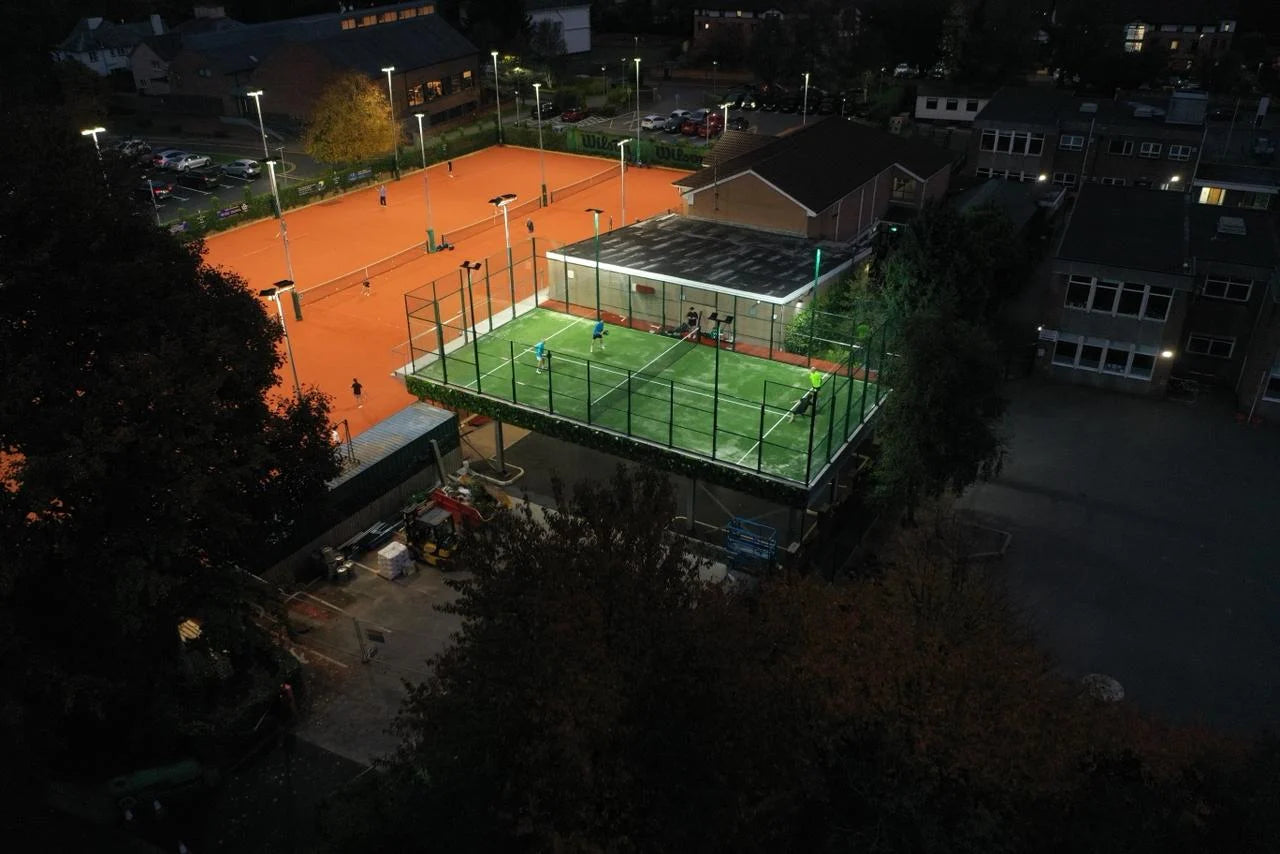
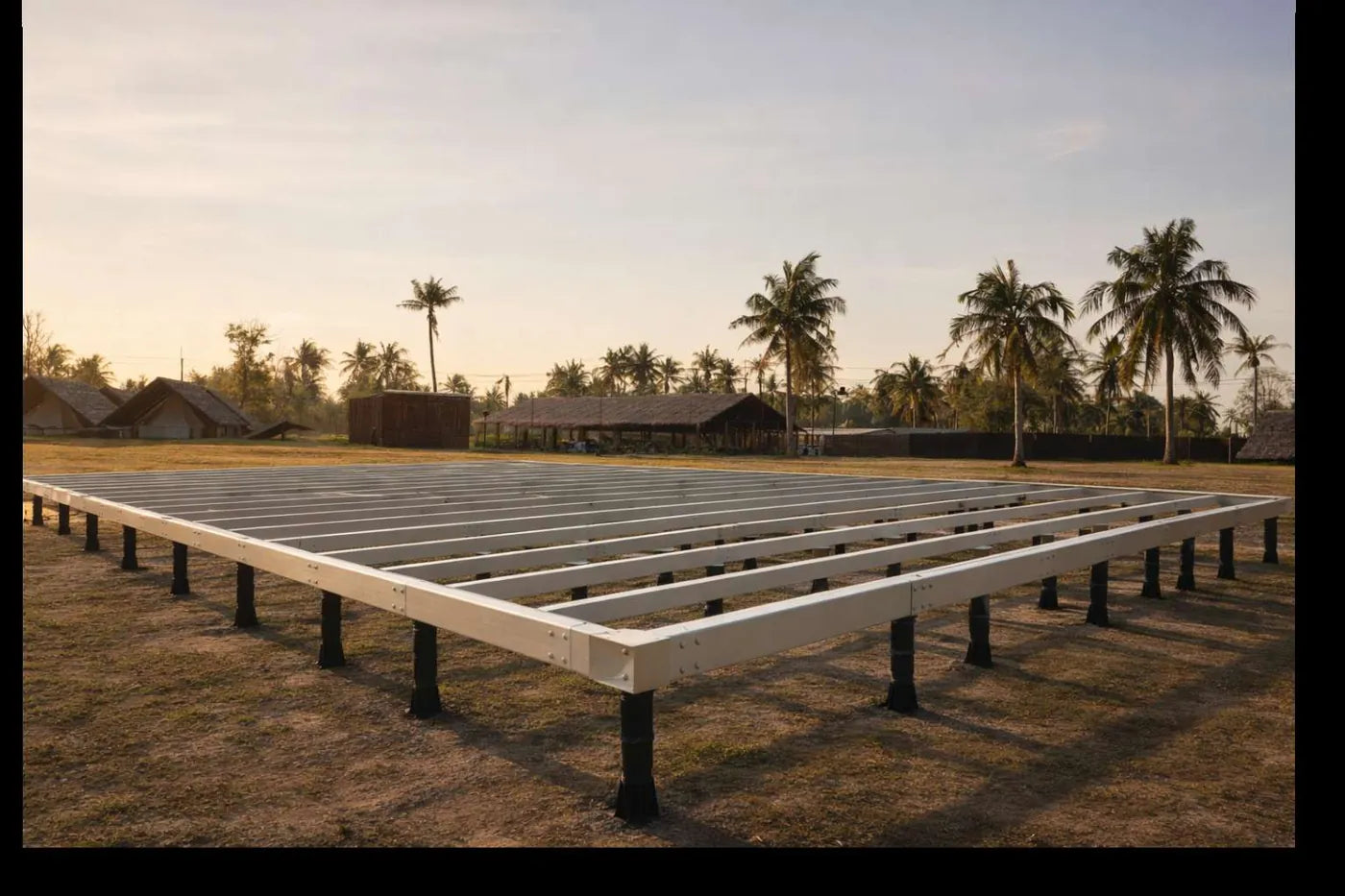
On sloping, soft or sensitive ground, the Prism Pano can stand on a raised platform base. It levels out up to 1 m of slope without pouring a slab, which suits hillside villas, resorts and temporary sites. It is available for the Prism Pano only. See raised and elevated padel courts.
Using an existing tennis court or car park
An existing tennis court, car park or sports hall floor can work if it is level, strong enough for the anchors and drains well. Many tennis courts are not flat enough for padel, so we check them first. See converting a tennis court to padel.
Foundation mistakes to avoid
- No drainage fall, so water stands on the turf.
- Pouring before the drawing is final.
- Forgetting cable ducts for lights.
- Too little time for the concrete to cure.
- Building the slab too small for the frame and run-off.
Get a fixed, itemised quoteSend us your site and number of courts. You get a layout, a timeline and a price, usually within 48 hours.
Get a quote
Prism Padel project team. We design, ship and install padel courts from Bangkok, Hong Kong, Stockholm and Oslo, with projects in the UK, Thailand, Singapore, Malaysia, Indonesia, Vietnam and Tanzania. Prices in this article are our list prices and estimates as of 9 November 2026.