Short answer
A covered padel court is an outdoor court under a roof, either an open-sided steel canopy, a membrane canopy or a fully clad sports hall. The roof must give at least 6 m clear height above the court, and 8 m is recommended. Our standard steel roof has a 10 m apex and 8–9 m at the sides. Roof cost depends on span, wind and snow loads and ground conditions, so it is quoted after a site visit, and covering 3–4 courts under one structure is much cheaper per court than covering one.
Why cover a padel court?
An outdoor court earns nothing when it rains, and little in the midday heat. A roof changes that.
- More bookable hours. Rain, snow, tropical downpours and strong sun stop being cancellations.
- Longer turf life. UV light and standing water are the two things that wear turf fastest.
- Better comfort in hot climates. Shade lowers the surface temperature, which matters in the Middle East and Southeast Asia.
- A premium feel. Covered courts can be booked at peak prices all year, and they are easier to sell to members and guests.
Open canopy, membrane roof or sports hall
| Open steel canopy | Membrane canopy | Clad sports hall | |
|---|---|---|---|
| Protects from | Rain and sun | Rain and sun, some wind | All weather, cold |
| Feels like | Outdoor, with air flow | Outdoor, soft daylight | Indoor club |
| Best for | Tropics, warm climates, resorts | Clubs that want daylight and a striking look | Cold or wet climates, year-round premium clubs |
| Lighting | On the court frame or roof | On the court frame or roof | Roof-mounted, such as LED Halo |
| Planning | Usually needed | Usually needed | Always needed, often as a building |
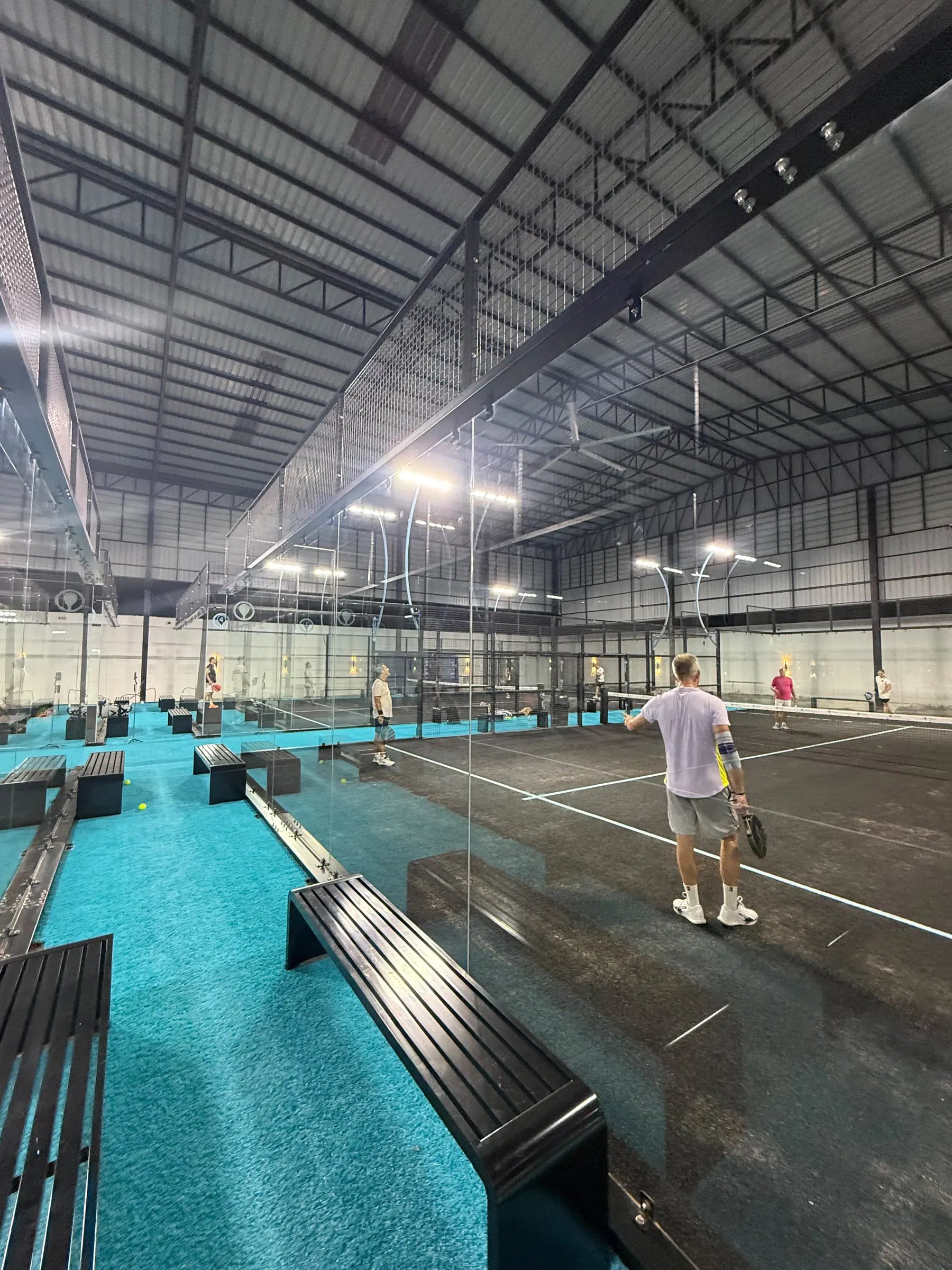
Open steel canopies are the most common choice in warm countries. Air moves freely, players stay cool and the court still feels like outdoor padel. Membrane canopies use tensioned fabric over a steel frame. They let in soft daylight and make a strong architectural statement. A clad sports hall adds walls, which gives full weather protection, better acoustics and the option of heating, at a higher cost.

How high does a padel court roof need to be?
The rules require a clear height of at least 6 m above the playing surface, and the LTA recommends 8 m for new builds. Lobs are a big part of padel, and a low roof punishes the best shots. Measure the lowest point above the court, including beams, lights and gutters, not the apex.
Our standard steel roof has a 10 m apex and 8–9 m at the sides, which keeps lobs free over the whole court. The out-of-court areas next to the court need at least 4 m.
Lighting under a roof
A roof changes the lighting plan. Under an open canopy, lights can stay on the court frame. In a hall, roof-mounted lights avoid poles and glare. We offer three LED options, all with a lighting layout drawing:
- Prism Flood, US$490 per court: 8 × 200 W LED floodlights on the court frame, IP66, the smart choice for multi-court clubs.
- LED Projects ICE X8, US$2,900 per court: eight 150 W linear lights, 334 lux average with 0.81 uniformity, anti-flicker for video.
- LED Halo, US$4,900 per court: a continuous ring of 48 linear LED fixtures on all four sides, mounted 6–8 m high and dimmable. Made for indoor and covered courts, with no light poles.
For reference, the LTA recommends 300 lux for recreational and club play and 500 lux for national and international competition. See the lights in detail on the Prism Pano page.
Climate and engineering
A roof catches wind like a sail, so it is designed by a structural engineer for local wind and snow loads. Some local rules worth knowing:
- United Kingdom: the LTA asks for hot-dip galvanized steel on all canopy supports and a minimum 15-year design life for canopy membranes, with the design submitted to Building Control. See padel courts in the UK.
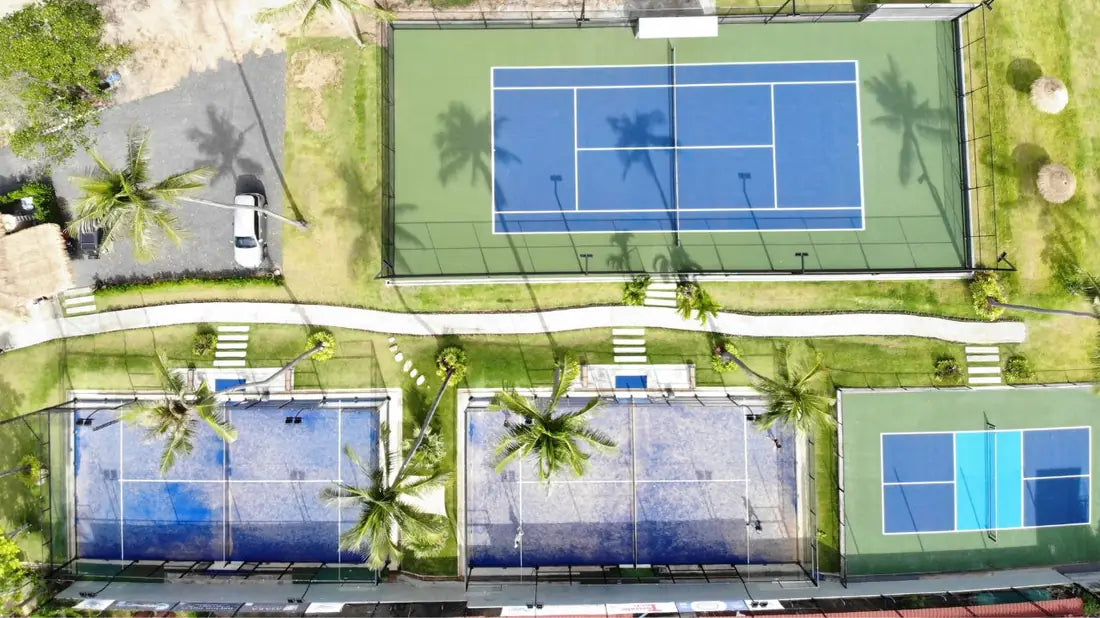
- Tropics: open canopies with good drainage and gutters sized for heavy downpours. At Prime Padel Samui in Thailand all courts play under one large steel roof.
- Middle East: shade and air flow matter more than rain. See padel courts in the Middle East.
- Australia: roofs and courts are engineered per site to AS/NZS 1170.2 wind loads. See padel courts in Australia.
Courts under an open canopy are still exposed to humidity and driven rain, so we galvanize the court frame just as we do for fully outdoor courts.
Do covered padel courts need planning permission?
Almost always. A roof is a structure, and in many countries it counts as a building. In the UK, new padel courts, 3–4 m fencing and floodlights already need planning consent, and a canopy adds Building Control approval. We supply court drawings and lighting layouts for your application. Start the application early, because it is often the longest step in the whole installation timeline.
What drives the cost of a padel court roof
Roofs are priced per project, not from a list, because the same roof costs very different amounts on different sites. These are the factors that move the price most:
- Number of courts. One structure over three or four courts costs far less per court than a roof over a single court.
- Span and height. A column-free span over the courts and their run-off needs heavier steel.
- Wind and snow loads. Coastal, cyclone and snow regions need stronger frames and foundations.
- Walls or no walls. Cladding, doors, ventilation and insulation turn a canopy into a building.
- Ground conditions. Column foundations depend on what is under your site.
- Drainage and gutters. Tropical rainfall needs large gutters and downpipes.
Add a roof to your quoteChoose “New steel roof” in the court builder. We price the courts instantly and quote the roof after a site visit.
Open the court builder
Prism Padel project team. We design, ship and install padel courts from Bangkok, Hong Kong, Stockholm and Oslo, with projects in the UK, Thailand, Singapore, Malaysia, Indonesia, Vietnam and Tanzania. Prices in this article are our list prices and estimates as of 9 November 2026.