Short answer
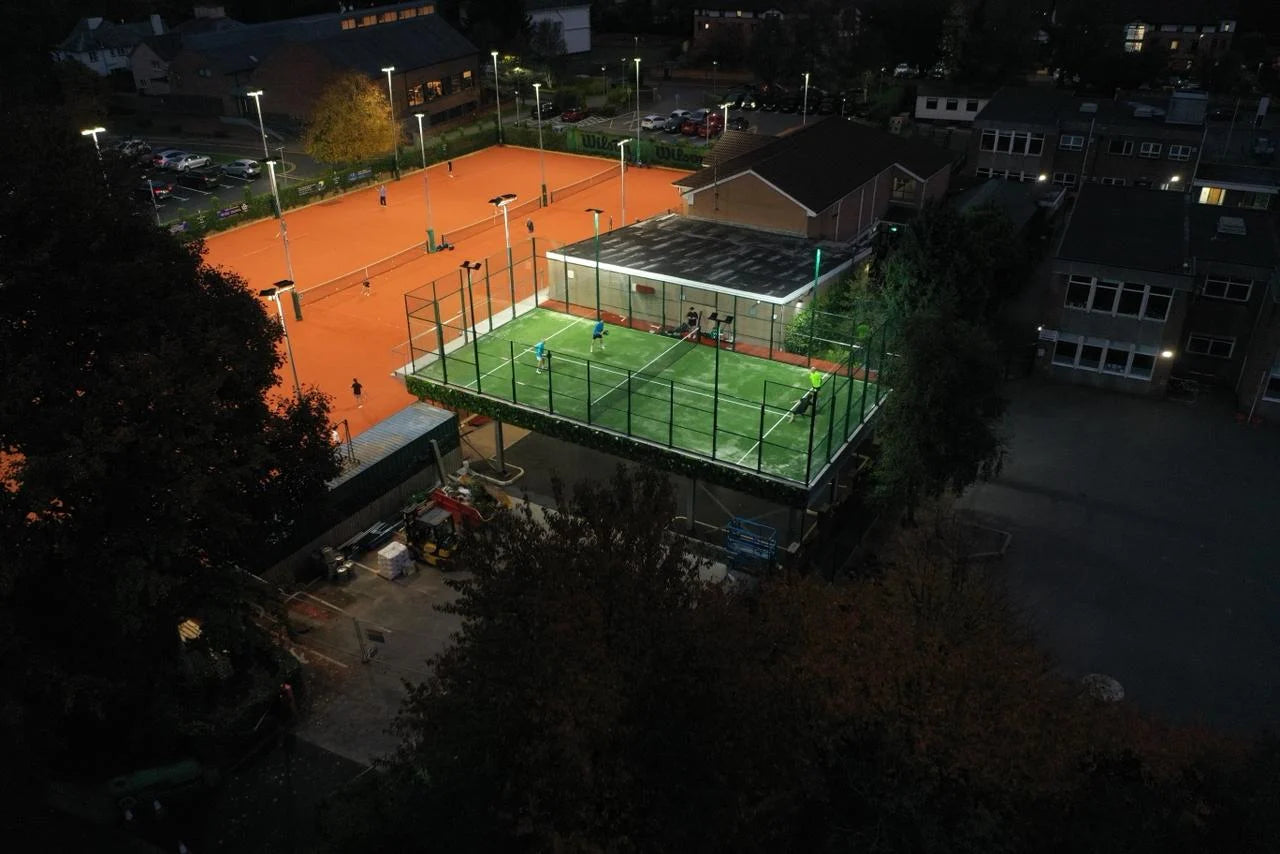
A padel court is an enclosed rectangle of 20 × 10 m with a net across the middle. The back walls are 3 m of glass topped with 1 m of mesh, and the side walls step down from glass to mesh. The structure is a steel frame holding 12 mm tempered glass, with sand-filled artificial turf on a concrete slab, and lights mounted on the frame or a roof. Players may hit the ball off the walls after it bounces, as in squash.
The parts of a padel court
- Steel frameUprights and beams that hold the glass and mesh. Outdoors it must be hot-dip galvanized under the powder coat. See foundations.
- Glass walls12 mm tempered safety glass on the back walls and the first part of the side walls. The ball bounces off them. See glass guide.
- MeshWelded steel mesh above the back glass and along the rest of the side walls. The ball is live off the mesh too, but the bounce is unpredictable.
- TurfArtificial grass, 10–12 mm, filled with silica sand. It controls bounce and grip. See turf guide.
- Net and posts0.88 m high in the centre, 0.92 m at the posts.
- DoorsOne or two openings in the side walls, so players can run out to play the ball back in. Prism courts ship with open entrances; doors are an optional add-on.
- LightsFloodlights on the frame, or a ring hung from a roof. See lighting guide.
Types of padel court
- Panoramic: large glass panels with slim corner pillars, such as the Prism Pano.
- Super panoramic: no corner pillars, the glass hangs from a top beam, such as the Prism Super Pano.
- Single: 20 × 6 m, for one against one. See single courts.
Compare them on court models and in panoramic vs super panoramic.
Lines and zones
A service line runs 6.95 m from the net on each side, and a centre line splits the service area into two boxes. Lines are 5 cm wide. See padel court lines and rules.
Space and setting
With walkways a court needs about 260 m². Indoors, allow at least 6 m clear height, 8 m recommended. Outdoors, plan drainage, wind and sun. See indoor requirements and outdoor courts.

Price your own courtsPick model, turf, lights and number of courts. The price updates as you click.
Open the court builder
Prism Padel project team. We design, ship and install padel courts from Bangkok, Hong Kong, Stockholm and Oslo, with projects in the UK, Thailand, Singapore, Malaysia, Indonesia, Vietnam and Tanzania. Prices in this article are our list prices and estimates as of 9 November 2026.